Socialism Isn't Winning. Crony Capitalism Is Losing.
Everyone is suddenly talking about socialism again.
The Right is dusting off the same old warnings.
Venezuela. Cuba. Communism.
Bureaucracy. Dependency.
Bread lines.
And yes, those criticisms are valid. Very valid.
But there is one question they never seem to answer:
What, exactly, are you offering instead?
Because if the answer is:
"Let's go back to the same system that made socialism attractive in the first place"...
Don't expect a standing ovation.
Because that system is not working for a growing number of Americans.
They know it. Because they feel it every time they try to buy a home, fill a grocery cart, save for retirement, or get ahead without an insider opening the gate.
The people defending the status quo know it too.
But most of them simply don't want it to change.
Why would they?
It works beautifully…
for them.
The Socialists Found an Open Wound
Socialism is not becoming attractive because millions of Americans suddenly forgot the twentieth century.
It is becoming attractive because the cultural marxists found an open wound... and the people who claim to defend capitalism refuse to treat it.
People see wealth and power concentrating into fewer hands.
They watch the price of homes climb out of reach while their money buys less every year. They watch giant institutions receive cheap capital, political access, bailouts, and opportunities ordinary people never see.
They work harder. They save. They follow the rules.
And still, ownership keeps moving farther away.
Then a socialist comes along and says, "Capitalism did this to you."
That is the trick.
Because what people are living under is not a free and competitive market.
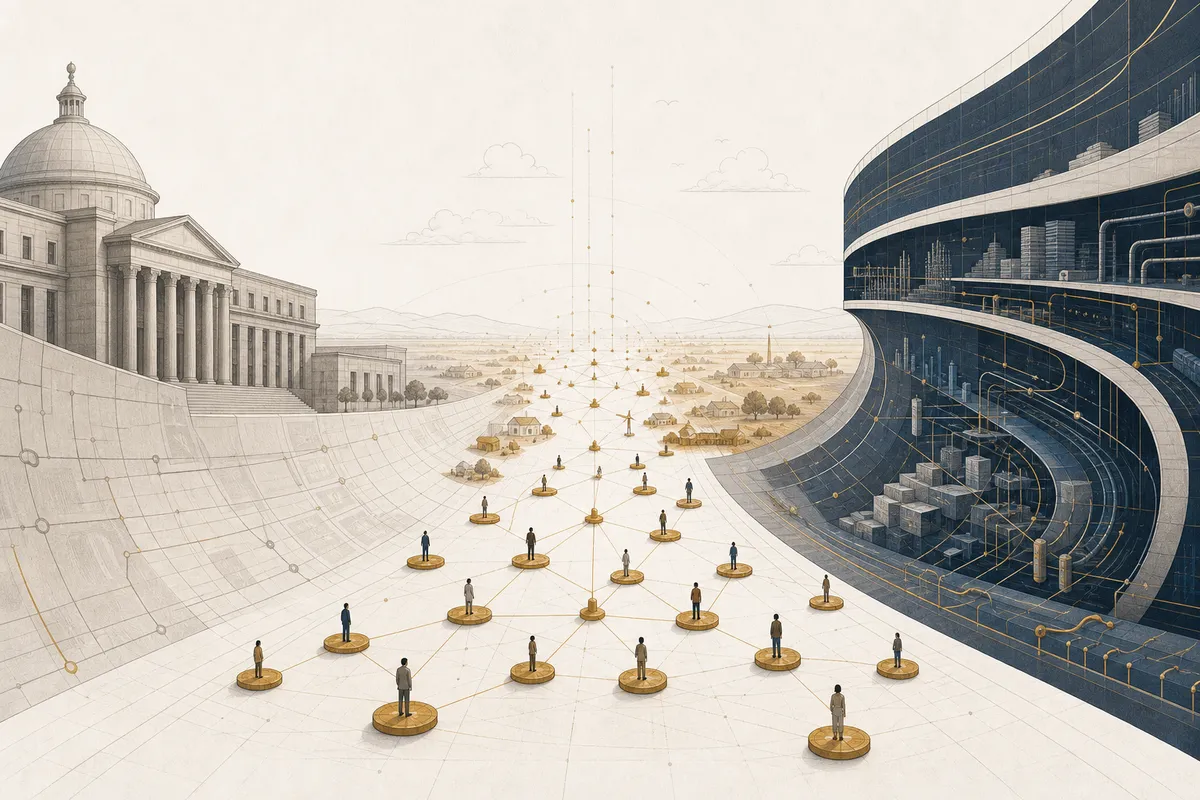
It is a system where government power and private power have wrapped themselves around each other so tightly that most people can no longer tell where one ends and the other begins.
They call it capitalism.
It isn't.
It is crony capitalism.
“Capitalism”: An Equivocal Term
The word “capitalism” has been hijacked.
Its defenders use it to describe private property, free exchange, open competition, and the discipline of profit and loss.
Its critics use it to describe the system Americans actually live under—bailouts, regulatory capture, monetary privilege, protected incumbents, and an ever-tighter marriage between government and concentrated private power.
Then both sides pretend they are talking about the same thing.
They aren’t.
Crony capitalism borrows the name and moral legitimacy of capitalism while violating its most important principles.
Socialists point to the damage crony capitalism creates, call it simply “capitalism,” and declare the case closed.
That equivocation traps the public inside a false dilemma:
Defend the rigged system. Or surrender even more power to the government.
The Problem Is NOT Capitalism
Real capitalism forces people to compete.
It rewards those who create value. It punishes those who destroy it. It protects private property, allows voluntary exchange, and lets bad businesses fail so better ones can take their place.
Crony capitalism does something very different.
It writes rules that protect the people already inside the walls. It hands politically important institutions a life raft when they sink their own ship. It pumps money into the system, drives asset prices higher, and then tells working Americans they should have invested sooner.
The gains stay private.
The losses get handed to the public.
That is not capitalism operating too freely. It is capitalism corrupted by political privilege.
And it has created the perfect sales pitch for socialism.
The socialist says, "This system concentrates wealth and power. Give government more control."
The defenders of the current system answer, "No. Keep things the way they are."
Those are not our only choices.
One concentrates power in the state. The other concentrates power inside institutions protected, financed, or favored by the state.
Both move power away from the individual.
That is the false choice nobody seems willing to challenge.
Government Is Becoming the Answer on Both Sides
This is not just a problem on the Left.
Left and Right are both starting to accept the same dangerous premise: when wealth and ownership become too concentrated, government must step in and fix it.
The Left reaches for redistribution, public ownership, price controls, subsidies, and more political direction of capital.
The Right now reaches for its own versions of government intervention.
In 2026, the federal government started placing $1,000 into investment accounts for eligible children born during a government-selected period. The stated goal is admirable: help more American children gain a stake in the economy.
But the government did not discover a new source of wealth.
It took money from current taxpayers, borrowed against future taxpayers, or created more claims against the same economy... and then redistributed that money to a selected group.
Worse, it routed the money right back into the same financial system whose concentration helped create the ownership problem.
Under the same institutional managers who already exert disproportionate power.
That is confiscation and redistribution dressed up as ownership policy.
The same flaw appears in efforts to stop large institutions from buying single-family homes.
Again, the concern is real. A family with a mortgage approval cannot compete on equal footing with a giant pool of coordinated capital making cash offers at scale.
But blocking one buyer does not make the family stronger.
It does not give citizens more knowledge, more capital, better tools, or the ability to organize. It treats the symptom while leaving the imbalance in place.
The goal should not be to make citizens permanent wards of government protection.
The goal should be to make citizens powerful enough to outcompete the institutions.
That solution will not come from another government program.
It will come from entrepreneurs, owners, and citizens willing to build something better.
Walled Gardens and Crony Capitalism
Crony capitalism does not need a smoke-filled room or a single mastermind. It works through rules, incentives, monetary machinery, and institutional advantages that favor those already closest to capital.
Accredited-investor rules. Sold as consumer protection. Functionally, they are a wall that decides who may enter the room before a single dollar changes hands. With rare exceptions, it does not test whether you understand the risk. It tests whether you are already rich enough to participate.
Minimum investment thresholds. Raising ten large checks costs less than raising and administering ten thousand small ones. But that efficiency is exactly why the wall stays up. Everyone raising the money has an incentive to keep the checks large and the participants few. The best deals remain available primarily to those already inside.
Uncontrolled money creation, with inflation as a stated policy goal. Not merely a side effect. A feature of the system. It raises asset prices, pushes homes farther out of reach, increases the cost of essentials, and leaves new market entrants facing a question nobody in charge wants to answer: When does the debt-fueled asset bubble finally burst?
There is a name for why this benefits some people first and hurts everyone else later: the Cantillon Effect. Banks, large institutions, government contractors, and preferred counterparties can spend or invest newly created money before it spreads through the economy and pushes prices higher. By the time it reaches an ordinary paycheck, the assets that paycheck is trying to buy already cost more. Those closest to the new money acquire assets. Those farthest from it lose purchasing power.
The bailout eras of 2008 and 2020 made the advantage impossible to ignore. Emergency lending and extraordinarily cheap capital flowed toward institutions. Ordinary savers watched asset prices rise, returns disappear, and purchasing power erode. The free money existed. It simply was not offered to everyone.
Bank money creation adds another layer. We do not have room here to fully unpack modern bank-credit creation, but when a chartered bank issues a loan, it does not merely transfer existing dollars from a depositor to a borrower. It creates money out of thin air. Unlike individuals, chartered banks can create new money and decide where it enters the economy, influencing which businesses expand, which industries receive capital, which assets attract demand, and who can buy before prices adjust.
Government participation creates an even larger imbalance. When government buys assets, guarantees risks, or provides preferential financing, it enters the market with powers no private investor can match. It can tax current citizens, borrow against future taxpayers, or create additional claims against the currency. No family, entrepreneur, or operating company can do the same.
Foreign governments are already deploying sovereign capital into American assets. Gulf sovereign wealth funds reportedly invested more than $130 billion in U.S. assets during a single year. Foreign ownership of American farmland has grown approximately 98% since 2010, reaching roughly 46 million acres. Meanwhile, a February 2025 executive order started planning for an American sovereign wealth fund, drawing comparisons to funds operated by countries such as Saudi Arabia.
That may be presented as an America-first answer to foreign sovereign capital. But government ownership is not citizen ownership. It answers concentrated foreign capital with concentrated government capital, gives even greater investment power to political officials and appointed managers, and creates additional upward pressure on asset prices for new market entrants.
In summary: Rules restrict access to the best opportunities. Transaction economics reward larger checks and fewer participants. Monetary policy favors those closest to newly created money. Chartered institutions direct new credit. Bailouts weaken the consequences of failure. Governments and sovereign funds enter markets with advantages citizens cannot reproduce.
Then the entire arrangement gets labeled “capitalism.”
We Replaced Stewardship With Financialization
Capital is not the enemy.
Capital builds factories. It starts businesses. It buys homes. It funds new ideas.
It turns a plan scribbled on a napkin into something real.
But capital is also power.
And somewhere along the way, we stopped asking what that power should build.
Financialization asks one question:
"What return can this capital produce?"
Stewardship asks a harder question:
"What should this capital build, preserve, and pass forward while producing a return?"
Profit matters.
Without profit, capital dies.
A business that cannot sustain itself cannot serve its workers, customers, owners, or country for very long.
But when return becomes the only value, everything else turns into a line item.
Workers become inputs. Communities become cost centers. Domestic factories become inefficient assets.
National resilience disappears from the spreadsheet because nobody assigned it a quarterly value.
That is how a country can become richer on paper while selling off the things that made it strong.
Coordinated capital does far more than earn returns. It shapes the future of a country (I explain how in this article).
Which raises an even more important question:
If capital represents power, who directs the power created when millions of people combine their capital?
The People Supply the Capital. The Institutions Direct the Power.
Most Americans play the game they were taught.
Work. Save.
Put money into a retirement account.
Invest for the future.
Hope there is enough waiting at the end.
That money flows into pensions, mutual funds, retirement plans, and other pooled vehicles. Citizens entrust institutions to manage it on their behalf.
There is nothing inherently wrong with that.
Pooling capital creates scale. Professional managers can bring real skill, discipline, and efficiency. Most people do not want to analyze hundreds of investments or vote on every decision before breakfast.
The problem begins when delegated management becomes unaccountable control.
The people supplied the capital. But the institutions direct the power created by that capital—often toward ends that conflict with the interests, values, and wishes of the people whose money they manage.
In other words…
Those who manage the People's capital do not answer to the People.
If control of capital is power, then those who exercise that control must be accountable to the people whose capital they control.
Not once every few decades.
Not through a stack of proxy documents nobody reads.
In a real, practical, and responsive way (more on that later).
Download The American Money Brief
The system is designed to lock you out. This guide kicks the door down and shows you how to build real wealth by saving America.
No spam. Unsubscribe anytime.
Check Your Inbox
The American Money Brief is on its way to your email.
Capital Has No Loyalty
There is another problem we rarely say out loud:
Capital has no loyalty of its own.
It has no family. No hometown. No flag.
No children who will inherit the country it leaves behind.
Those loyalties must come from the people who direct it.
When capital moves around the world with only one mandate—find the greatest return—pure financialization becomes the natural result.
American businesses become entries in an international portfolio.
American land and housing become globally tradable assets.
Domestic factories compete against whatever location produces the best number this quarter.
Communities become costs.
Workers become interchangeable.
National resilience becomes invisible.
The problem is not that every foreign investor is hostile. It is not that capital should never cross a border.
The problem is that capital can exert enormous power over a nation's productive assets without owing any loyalty, responsibility, or accountability to the people who live there.
When financial return is the only mandate, national stewardship becomes somebody else's problem.
Until there is no somebody else (more about this too later).
The Socialists Understand One Thing the Right Forgets
The socialists understand organization.
"Workers of the world, unite" pointed toward a disastrous destination.
But the organizational insight was real.
Fragmented people possess limited leverage.
Organized people possess enormous leverage.
So borrow the tactic and reject the economics.
Unite voluntarily instead of at the end of a gun barrel.
Coordinate private capital instead of collectivizing property.
Build shared incentives instead of political coercion.
Keep accountability and the right to walk away.
The promise of socialism is simple:
Unite forcibly. Surrender control. Divide what little remains.
The promise of the system I am proposing is the opposite:
Unite voluntarily. Retain ownership. Build wealth. Become more free in a more prosperous country.
Socialism organizes people so the state can control capital.
We should organize citizens so they can control their own capital.
Don't seize the means of production.
Own them.
Own the Means of Production ≠ Own Public Stocks
Now, when most people hear “own the means of production,” they think about buying stocks.
And public markets have real value. They give ordinary people liquidity, diversification, and a way to share in the growth of great companies.
But buying shares through a retirement account is not the same as directly acquiring and stewarding productive assets.
As we have already seen, public markets give citizens financial exposure while routing much of the practical control through the institutions managing their capital.
That does not make stocks bad.
It means stocks alone cannot solve the ownership and control problem we are talking about.
If citizens are going to build real economic power, they also need a path into the private assets that make up the productive backbone of the country—businesses, real estate, farms, infrastructure, and the deals where ownership and decision-making can still remain closely connected.
And that is where the next problem appears.
Private assets are far harder to find, evaluate, finance, acquire, and manage than clicking “buy” inside a brokerage account.
A Real Alternative Has to Be More Than a Slogan
Of course, telling people to “go buy a business” or “go acquire real estate” is not a solution.
If it were that easy, they would already be doing it.
Citizens face a wall of connected barriers.
Most were never taught how deals create wealth. Their capital is scattered. Finding opportunities costs money. Evaluating them takes skill. Lawyers, brokers, lenders, administrators, and other middlemen take their cut at every step.
And even when citizens build something valuable, a larger pool of institutional capital often waits at the end to buy it.
This is why the alternative cannot be one product, one fund, or one clever app.
It has to be a system.
A system that develops capable owners, coordinates capital, lowers the cost of action, creates trust, and then scales without stripping the owners of control.
Representation Without the Blank Check
Any system capable of coordinating citizen capital at scale eventually confronts the same problem: pooling capital requires delegation, but delegation usually becomes surrender.
And people should be able to unite their capital without permanently surrendering control over it.
Nobody wants to vote on every property repair, every hire, or every acquisition decision. Professional managers need the authority and room to manage.
What is needed is a fund-governance model built on revocable consent to delegated authority—a structure that functions more like a representative republic than a permanent blank check.
But governance is only the mechanism.
What’s needed are funds that are purpose-built to coordinate citizen capital around the productive assets America needs—to rebuild domestic capacity, strengthen communities, restore national resilience, and create wealth for the citizens providing the capital.
Under this model, fund managers are elected with two primary mandates:
- To rebuild the US economy
- To produce positive returns for investors
Citizens establish the fund’s broad direction and mandate—things like which sectors to prioritize, which types of assets to acquire or create, and how the fund should contribute to strengthening the American economy.
Elected fund managers handle daily decisions and execute that mandate.
Citizens do not micromanage the professionals. But when managers materially abandon the mandate they were elected to carry out, citizens retain the ability to recall them.
A bad quarter is not a betrayal. Real investment theses need time to work. Financial performance must be judged over intervals long enough for stewardship and strategy to produce results.
But managers who betray the trust of those whose capital they are managing must be held accountable.
That is the balance:
Citizens set direction. Managers execute. Citizens retain the right to withdraw delegated authority when representation fails.
Revocable consent to delegated control.
Representation without the blank check.
This is the governance model proposed for America Money’s America-First Funds.*
There is a long road ahead. And many obstacles to clear before we get there. And it is not the entire solution.
A better-governed fund cannot, by itself, fix everything that is wrong with the current crony-capitalist system.
But it solves one of the hardest problems any larger ownership system must eventually confront:
How do we achieve institutional scale without reproducing institutional unaccountability?
America First Funds are designed around participation and control by verified American citizens only because the people directing power over American productive assets should have a direct stake in the country’s long-term prosperity.
Citizenship does not guarantee wisdom or virtue.
But it creates an essential alignment:
The people directing the capital must live with what that capital builds—or destroys.
The Third Choice
This is the type of alternative capitalism's defenders have failed to offer.
Not another speech about free markets while politically protected institutions keep the best opportunities behind locked doors.
Not another government program that confiscates money, redistributes it, and calls the result empowerment.
Not a socialist system that promises to cure concentrated power by concentrating even more power in the state.
A competing ownership system.
Training that creates capable owners. Deal Clubs that coordinate citizens around real opportunities. AI that cuts costs. Blockchain that strengthens trust and accountability. DeFi that removes unnecessary toll booths. America First Funds that bring citizen-aligned capital to institutional scale.
And stewardship that asks capital to do more than make the number go up.
This is how better institutions replace inferior ones.
Not by asking government to destroy the competition.
By beating it.
By allocating capital better. By producing strong returns. By lowering costs. By preserving productive assets. By serving the people whose capital gives the institution its power.
That is capitalism.
Capitalism Needs a Reformation, Not a Funeral
The answer to corrupted capitalism is not socialism.
And the answer to socialism is not defending the system that made socialism attractive.
The answer is a capitalism where ownership carries real power. Where competition disciplines institutions. Where failure has consequences. Where citizens can coordinate without collectivizing. Where professional managers remain accountable. Where capital builds productive wealth instead of strip-mining the country that created it.
For generations, Americans faced an ugly tradeoff.
Remain fragmented and retain control... or aggregate capital and surrender it.
That tradeoff no longer has to govern our future.
Unite the capital. Keep the ownership. Delegate the authority. Retain the right to take it back.
If you want to see how the complete system fits together—from training and Deal Clubs to AI, DeFi, and America First Funds—start here.
Because pointing at the problem is easy.
Building the alternative is where the real fight begins.
*America First Funds are a proposed future component of the American Money ecosystem and do not currently exist or accept investments.