Upstream of Everything: The Power That Decides America's Future
Fire every D.C. politician tomorrow.
All 535 of them.
What changes?
Nothing.
Not the debt.
Not the culture.
Not the fact that the game is rigged…
… and you're not the one it's rigged for.
Sounds crazy, right?
But stay with me, because once you see why it's true, the chaos of the last decade…
… the double standards, the manufactured outrage, the fact that every crisis benefits the same people…
Finally makes sense.
Because while you've been trained to watch the outcomes.
The headlines.
The elections.
The latest political fight.
Today is the day you see the machinery producing those outcomes. The real source of power in this country. The force that steers culture, politics, and the economy.
And once you see it, you'll never watch another news cycle the same way.
Real Power Doesn’t Live Where You Think
Real power doesn’t live in elections.
Real power lives with those who control the capital.
Not the White House.
The flow of money.
At scale.
Don’t believe me?
Keep reading.
You’ll see.
Wealth Isn't a Pile. It's a Steering Wheel.
Most people picture wealth as a pile of money.
Big pile, big yacht.
Annoying? Maybe. Depends on the day.
Dangerous though?
Not really.
Truth is: capital at scale isn't a pile—it's authority.
The power to decide what gets built… and what gets starved.
Which companies live.
Which towns die.
Which ideas get a megaphone and which get a muzzle.
But…
Owning exposure is not owning control.
Your 401(k) gives you exposure. Not control.
Market goes up, your statement goes up.
But the votes attached to your shares?
Someone else casts those.
Three firms — BlackRock, Vanguard, and State Street — are the largest shareholder in roughly 88% of the S&P 500, and together they cast about a quarter of all votes at those companies' meetings [1].
Millions of Americans "own the market."
A handful of people vote it.
And before anyone twists this: the steering wheel itself isn't evil.
Capital allocation builds things.
Funds payrolls in your town.
Supplies the benefits of modern society.
When Elon Musk bought Twitter, that was capital allocation winning a fight for free speech that our “leaders” weren’t even willing to take on [2].
So the problem isn’t the fact that capital steers.
The problem is that many of those who hold the wheel today use that power in ways that harm the very people who keep this country running.
How?
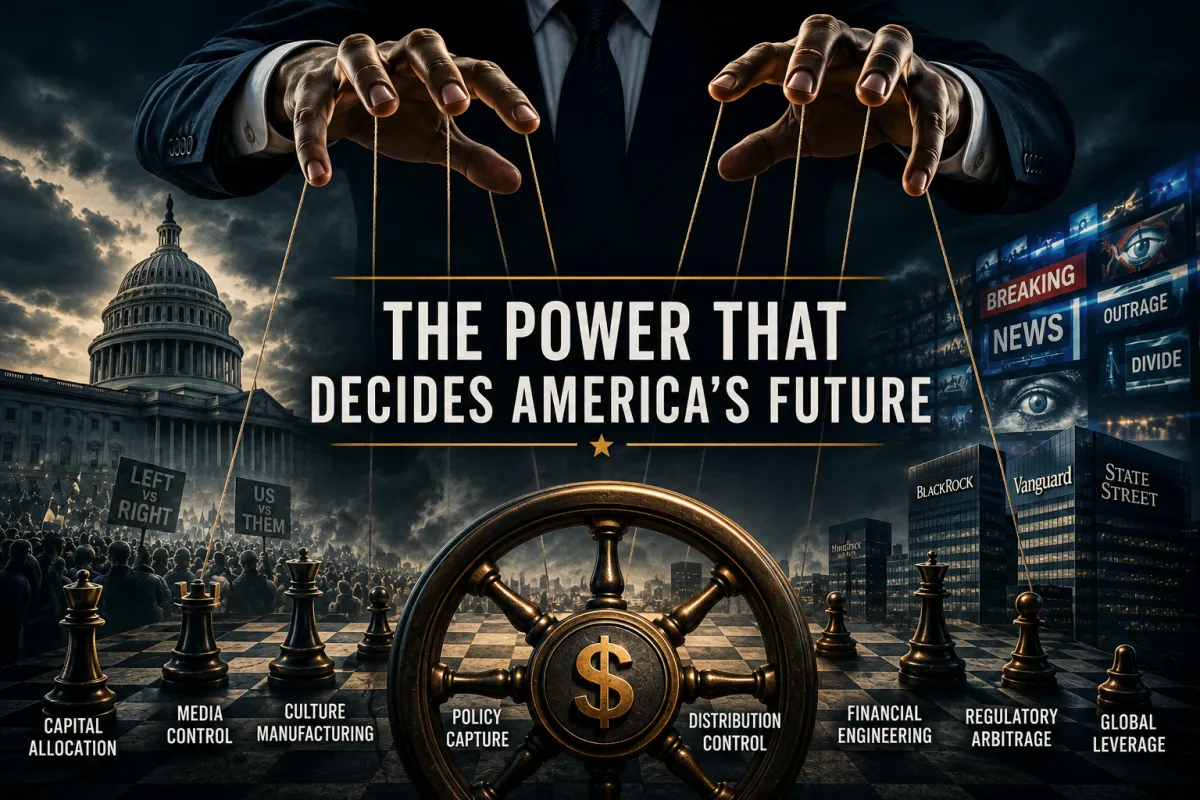
Eight “levers.”
Levers that give those who control capital real power.
Power that shapes culture, politics, and the economy.
Let’s break each of them down.
Lever 1: The Money Votes Before You Do
If you control the money, you don't need laws. You already control outcomes.
Before a single bill gets drafted, funding decisions already determined which companies, industries, and ideas exist to fight over.
You and I don’t get a vote on where capital flows.
- The top three banks hold about 40% of America's banking assets [3].
- The top tier venture capital firms control over 70% of the money, and in 2025 roughly 70% of all US venture funding went to just 389 companies [3].
- More than $30 trillion now moves under ESG mandates—trillions steering entire industries toward priorities that do more harm than good [4].
Who gets funded?
Who gets starved?
Who survives the downturn?
Who disappears?
Those decisions are made by the few who control the capital.
Lever 2: The Stories That Don't Run
Not a trick question:
Who controls the media?
The owners.
The second power lever for those who control capital is media control—and it cuts with two blades.
The first blade is salience: deciding what feels important and what feels fringe.
Throttling, demonetizing, burying—none of it needs a law, because it's all terms-of-service.
Which topics get air-time? What positions do the talking heads take? Who gets banned?
The owners decide.
And ownership is tight: in a recent twelve-month stretch, more than half of all visits to major American news sites went to outlets controlled by just seven families or corporate entities [5].
The second blade cuts deeper: silence.
The stories that don't run.
You can fact-check a lie. You can't fact-check a blackout.
Doubt it?
Think back.
October 2020. Right before an election.
A two-century-old American newspaper publishes a well-documented story about a presidential candidate's son (cough-Biden).
Twitter (pre-Musk) blocks the link across the platform. You couldn't even share it in a private message.
The paper's own account gets locked.
Facebook quietly strangles the story's reach while its "fact-checkers" take their time.
The story goes into a black hole.
Internal messages later get dragged into the sunlight by congressional hearings, showing takedown requests (from the candidate it would have harmed) handled like room service: "More to review from the Biden team." ... "Handled these." [6]
The first amendment didn’t go away. There was no government order.
The team pushing for the censorship wasn’t even in office.
But the ones calling the shots. Those with real power over the media corporations. They had an agenda.
And a valid argument can be made that their actions swayed the outcome of that election.
That's the second lever:
When you own the pipes, you decide what flows.
Lever 3: Fund the Culture = Set the Frame
The third lever is culture manufacturing.
The tools?
Entertainment and advertising.
Entertainment never argues with you. That's what makes it powerful.
It just quietly sets the frame you argue inside—what a family looks like, what a man is, what's admirable, what's shameful.
By the time an idea shows up on a ballot, the movies and the ads decided how it feels years ago.
And advertising is the enforcement arm.
Which shows live, which platforms die, which creators eat—those are allocation decisions wearing a media costume.
When Congress dug into the ad industry's "brand safety" alliance, the report title said it plainly: "GARM's Harm: How the World's Biggest Brands Seek to Control Online Speech." The alliance folded within weeks of the spotlight hitting it [7].
Here's the truth this whole section teaches, and it's worth memorizing:
Culture sits upstream of politics.
But capital sits upstream of culture.
People argue about a "deep state" of bureaucrats.
Think bigger.
The deeper state reads you the news, calls the game on Sunday, writes the sitcom, scores the movie, and hands out the microphones.
It never needs orders from anyone — because it shares owners and funders.
Lever 4: A Thousand Hours a Year
The fourth lever is education—the long game.
Your kid spends over a thousand hours a year inside institutions shaped by grants, endowments, and accreditation boards.
You get minutes a day.
If you're disciplined.
Now do the math on who's really raising the next generation.
(ask me why I homeschool)
This isn't a theory.
One foundation poured more than $6 billion into reshaping American schools—including roughly $300 million to develop and push Common Core, which 45 states adopted, with adoption tied to eligibility for $4.5 billion in federal grant money [8].
One checkbook.
One generation's curriculum.
Change what a generation is taught to think and believe, and twenty years later you don't need to persuade the country.
You raised it.
Lever 5: The Menu Is Printed Before You Order
The fifth lever is campaign underwriting.
Elections cost money.
And the big checks don't come from voters.
In the 2024 cycle, just over 1% of Americans—the folks writing checks bigger than $200—supplied more than 78% of all federal campaign money [9].
Understand what this lever really is: a filter, not a bribe.
The rigging happens before you ever see a ballot.
The menu of "viable" candidates was printed by whoever could raise—and nobody who threatens the system makes the menu.
Both parties pass through the same filter. That's not a both-sides shrug; that's how the machine survives elections.
And the selected candidates are never allowed to forget who they really work for.
Download The American Money Brief
The system is designed to lock you out. This guide kicks the door down and shows you how to build real wealth by saving America.
No spam. Unsubscribe anytime.
Check Your Inbox
The American Money Brief is on its way to your email.
Lever 6: They Don't Bribe Politicians. They Hand Them the Pen.
The sixth lever is political capture.
Money doesn't just pick who governs. It drafts what they sign.
Literally.
Model bills written inside donor-funded institutes were introduced roughly 2,900 times in state legislatures over eight years—more than 600 became law [10]. Word for word, copy and paste.
Then there's the revolving door:
Federal lobbying hit a record $5 billion in 2025. Twenty lobbyists per member of Congress [10].
Nearly two-thirds of departing members of Congress walk straight into lobbying and influence work [10].
The unelected referees do it too:
FDA commissioners land on pharma boards.
SEC lawyers walk into the Wall Street firms they were just investigating.
One FCC commissioner even approved the Comcast merger—then took a job at Comcast [11].
And researchers found that regulators eyeing industry paychecks (aka their next job) bring fewer enforcement actions and write cheaper rules on their way out the door [10].
In other words:
The watchdog is being interviewed by the wolf.
And if they want the job, they know when to look the other way.
So you tell me… who do they really answer to?
Lever 7: Laws on Paper, Power in Practice
The seventh lever is the one almost nobody watches: selective enforcement.
Laws exist on paper.
Power decides how they're applied.
Quick — name your district attorney.
Exactly.
That's what makes those races dirt cheap to buy and devastating to own.
George Soros—one prominent, well-documented example among many—directed at least $40 million over a decade into electing roughly 75 prosecutors.
Those prosecutors now hold jurisdiction over one in five Americans and preside over about 40% of the nation's homicides [12].
A couple million dollars per race, and enforcement priorities flip overnight. No statute changed. No debate held.
Same capital. Different lever.
Lever 8: Chaos Is Profitable — If You're Buying
The eighth lever is crisis arbitrage.
Unrest looks spontaneous.
Until you follow the money.
So follow it.
The bail-fund network that scaled nationwide in 2020 raised over $100 million in six months.
Its parent organization is a fiscally sponsored project of the Tides Foundation, and the network itself launched with a $404,800 grant from a major philanthropy [13].
“Nonprofits” hire paid organizers and build mobilization machinery—the job postings are public.
And this year, the FBI's own investigators say they're tracing "nefarious" protest funding through webs of nonprofits [13].
Does that mean every protester is on a payroll?
No.
It means the unrest has infrastructure—and infrastructure has funders.
Now watch what instability does to prices.
Shocks crush them.
Whoever holds cash at the bottom buys from whoever can't hold on.
After 2008, institutions bought foreclosed American homes by the truckload at fire-sale prices and became landlords to the families who'd lost them [14].
During COVID, roughly 91,000 small businesses closed for good in six months—while thirteen of the biggest retailers grew their profits 40% in a single year [14].
Today, private equity sits on nearly $4 trillion in dry powder. Cash, loaded and waiting for the next fire sale [14].
Chaos is profitable—if you're buying.
Eight Levers. One Machine.
Stop and look at the whole board.
Every lever benefits the same people.
These aren't eight separate scandals. It's one compounding engine:
Control ensures extraction.
Extraction funds consolidation.
Consolidation creates more capital.
More capital buys more influence.
Influence protects the consolidation.
Around and around.
The levers aren't pulled in sequence—they're held all at once, and each one covers another's flank.
Allocation crowns the winners.
Media and culture make them look inevitable—or bury the story.
The schools raise kids who never think to ask.
Underwriting and capture protect them.
Enforcement spares them.
And when the crash comes, they buy the wreckage at a discount.
Don't take my word for it. Run your own test.
Think of the story that made you angriest in the last five years. Whatever it was.
Now push it through the machine:
Who funded it?
Who covered it—or didn't?
What did the shows and the ads glorify while it happened?
What were the schools teaching about it?
Who was allowed to run for office on it?
Who wrote the rule?
Who got prosecuted—or didn't?
And who owned more when it was over?
That's why those who control capital stay in power.
If one lever fails, the machine just routes through the other seven.
Is This a Conspiracy? Let's Be Honest.
This is where most writers flinch.
They either deny coordination exists, or they claim one shadowy room runs everything.
Both are wrong.
The truth comes in three layers, and each stands on its own evidence.
Layer one: no conspiracy required.
Concentrated ownership plus aligned incentives produces coordinated outcomes with no command center at all. Every allocator protecting his own position generates the pattern.
That's worth saying plainly—it's why the machine keeps running even when nobody's conspiring.
Layer two: values holding a checkbook.
People in power decide from their beliefs, same as you.
The difference is scale.
That's the honest explanation for ESG and DEI sweeping corporate America while customers never asked and returns never justified it: those programs reflect the values of the people holding the allocation pen [15].
And catch the loop…
Capital paid to build the culture that installed those values in the people who now allocate the capital.
Yesterday's culture spending produced today's allocators.
It shows up in the corner office too.
More and more, leaders get picked for ideological alignment instead of performance—and their private agendas outrank the first duty of management: the success of the business.
You've watched the results.
Bud Light's stunt cost Anheuser-Busch billions in market value and knocked America's #1 beer down to #3 [16].
Cracker Barrel's rebrand torched as much as $200 million in days and sent traffic down 8% [16].
Harley-Davidson.
Disney.
The list keeps growing.
And when the backlash forced the walk-backs? That doesn't disprove the capture—it proves it.
If those decisions had been market-driven, there'd have been nothing for customers to revolt against. The reversals show the power of the people answering an imposition. They don't show the imposition never happened.
Layer three: coordination in their own words.
At some level, coordinated agendas absolutely exist—in the open, on the record—and pretending otherwise is naive.
Soros has spent decades funding a network aligned with his published worldview; he calls nationalism "the dominant ideology in the world now" and treats it as the enemy of his open-society project [17]—and his prosecutor project shows the worldview cashing checks.
BlackRock's Larry Fink, on stage in 2017: "You have to force behaviors, and at BlackRock we are forcing behaviors." [18]
The World Economic Forum published and promoted the essay and video that told you: "You'll own nothing. And you'll be happy." [19]
The UN's Agenda 2030 spells out its program in documents anyone can read [20].
These are far from the only names. They're just the ones easy enough to prove with 10 minutes and a search engine. And the takeaway isn't the names—it's that the machine doesn't need any one of them to keep running.
And if this is how they speak in the open, you can imagine what they might do in private.
The Machine Works—Just Not for You (Yet)
Let's be clear about one thing.
The machine isn't broken.
Capital formation works.
Markets work.
Businesses create value.
Investment builds factories, funds innovation, creates jobs, and lifts living standards.
That's how prosperity is created.
The problem isn't that these levers exist.
The problem is that too many of them have become concentrated in too few hands.
When the same institutions influence what gets funded, what gets covered, what gets taught, what gets regulated, and who gets rewarded, the system gradually stops serving the many and starts serving itself.
That's not the inevitable outcome of capitalism.
It's what happens whenever ownership becomes concentrated and accountability disappears.
The encouraging news is that concentration isn't permanent.
Power can be centralized.
It can also be distributed.
History has shown both.
That's why understanding these eight levers matters.
Not so you can become cynical.
So you can become impossible to manipulate.
The next time a news cycle explodes, don't ask who's winning the argument.
Ask yourself:
- Which lever is moving?
- Who benefits if I believe this?
- And what am I not being shown?
Once you start asking those questions, you'll never consume the news the same way again.
But there's an even bigger question.
The Takeaway
If concentrated ownership created this machine...
What does broadly distributed ownership look like?
What happens when millions of citizens become owners instead of spectators?
When families own productive assets instead of simply consuming what others produce?
When capital begins flowing toward communities instead of away from them?
When millions of Americans unite their capital to rebuild this country?
That's the question we'll begin exploring next.
Because understanding the machine is only the first step.
Learning how to build something better is where the real work begins.
And that work belongs to all of us.
Whoever controls the system controls who the system rewards.
The future belongs to those who understand the system—and choose to build one worthy of free people.
— Michael Hearne
Sources
- Harvard Law Corp Gov — Big Three Power
- NPR
- Visbanking ranking
- GSIA Global Sustainable Investment Review
- FAIR — The Digital Media Oligarchy
- House hearing record
- House Judiciary report coverage / MarketingWeek
- NEPC — How Gates spent billions to change public education
- OpenSecrets — Donor Demographics
- Center for Public Integrity — copy-paste legislation
- BioPharma Dive — Gottlieb
- LELDF Justice for Sale report
- Chronicle of Philanthropy
- GAO-24-106643
- Bloomberg — Engine No. 1 wins seats
- CBS — Cracker Barrel value loss
- Soros tweet
- Forbes — 2017 video fueled ESG/DEI outrage
- Wikipedia — provenance summary
- UN DESA — official text/PDF